REVIEW · DUBLIN
A Self Guided Walking Tour of Dublin’s Docklands
Book on Viator →Operated by VoiceMap Audio Tours · Bookable on Viator
Dublin Docklands has a lot to say. This self-guided audio walk lets you hear the stories as you move, with offline audio and route maps so you’re not tied to signal. You’ll trace the riverfront from old trade power to today’s tech and culture in under two hours.
What I like most is the pacing and clarity: the narration is easy to follow, and the walk feels like a manageable stroll rather than a long grind. I also like how the route threads real landmarks together, from the Custom House to bridges and memorials that explain why this area matters.
The one drawback to plan around is simple: you bring your own smartphone and headphones. If you forget them, you’ll be stuck reading signs instead of getting the full Docklands story.
In This Review
- Key things to know before you go
- Walking Dublin Docklands with an audio guide you control
- Start at the Custom House and see why trade shaped everything
- Custom House to the quays: neoclassical trade power, then warehouses and change
- James Connolly, Liberty Hall Theatre, and labor history on the move
- Busáras, Connolly Station, and the Docklands as a transport crossroads
- IFSC and the skyline shift: from ships to finance
- Triumphal Arch and the Scherzer Rolling Lift Bridges
- Famine Memorial and the stories of those who were lost
- The Jeanie Johnston replica and the Great Famine emigration theme
- Cross the Liffey on Seán O’Casey Bridge for views and momentum
- Convention Centre Dublin, Admiral William Brown, and port memory
- Diving Bell and the maritime infrastructure details that people miss
- Tom Clarke Bridge (East-Link Bridge), BrewDog, and the “daily life” angle
- Sea lock, Grand Canal Docks sign, and the canal shift to Grand Canal Square
- Price, timing, and why $11.99 can make sense
- Logistics that matter: language, equipment, and where transit helps
- Who this Docklands walking audio tour is best for
- Should you book this Docklands audio walk?
- FAQ
- How long is the self-guided walking tour?
- What language is the audio tour available in?
- Do I need my own smartphone and headphones?
- Can I use it with offline maps and audio?
- Where do I start and where does it end?
- Is the tour refundable or changeable after booking?
Key things to know before you go
- Offline audio and maps let you keep moving even with spotty mobile service
- Local-insider narration turns a list of buildings into a connected walk
- A tight route (about 50 min to 1 hr 10) fits well between other Dublin plans
- Riverfront-to-canals routing means you get both dock heritage and modern Docklands
- Ends at Grand Canal Square / Red Sticks Dublin, a handy finish point for food and drinks
Walking Dublin Docklands with an audio guide you control
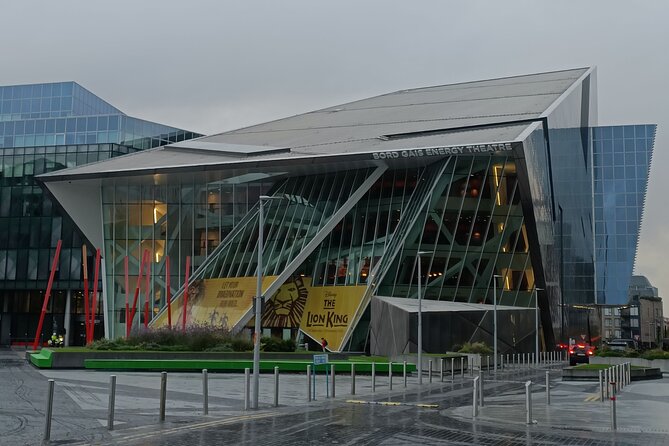
If you like exploring at your own pace, this is the kind of tour that fits. You pick your speed, pause when something catches your eye, and keep going when you’re ready. There’s no group waiting at corners, and that alone makes the experience feel less stressful.
The Docklands stretch can look like a mix of old and new. The audio format helps you connect those dots. Instead of reading a few plaques and hoping you get the full story, you get a guided narrative as you pass the major riverfront sights. That’s a big deal in Dublin, where names and dates often overlap across trade, labor, and emigration.
You also get offline access, which is practical. Dublin mobile data can be fine, but it’s never guaranteed. Here, audio, maps, and geodata are available without relying on constant coverage. Translation: you can spend more time looking up and around, and less time checking your phone.
You can also read our reviews of more walking tours in Dublin


Start at the Custom House and see why trade shaped everything
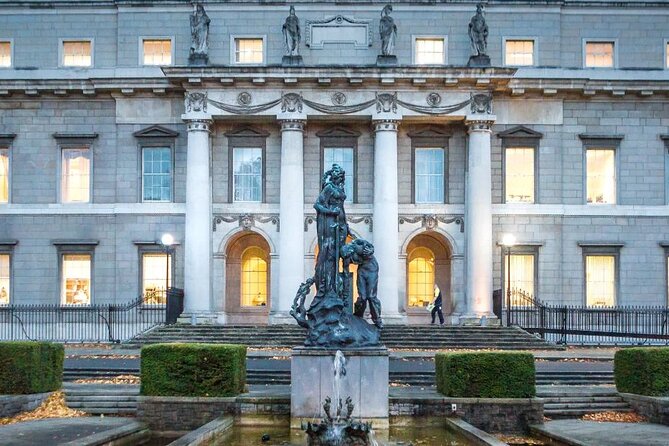
Your walk begins at the Custom House on North Wall in Dublin 1. This is a strong opening choice because the building’s purpose is obvious even before the audio explains it: this was tied to Irish trade and commerce. When you start here, the Docklands stops feel less random. You’re entering a district with a job.
From the start, you’ll be in the thick of Dublin’s maritime world. The audio frames the area as the former heart of the city’s maritime industry, now turned into a thriving urban district. That’s the theme running through the whole route: industry became infrastructure, and infrastructure became neighborhoods, offices, and cultural spaces.
A quick practical thought: since the start point is near major transit and O’Connell Street is within a reasonable walk, you can line this up neatly with other sights. If you’re starting fresh in the city center, this route gives you an easy “move east” plan.
Custom House to the quays: neoclassical trade power, then warehouses and change
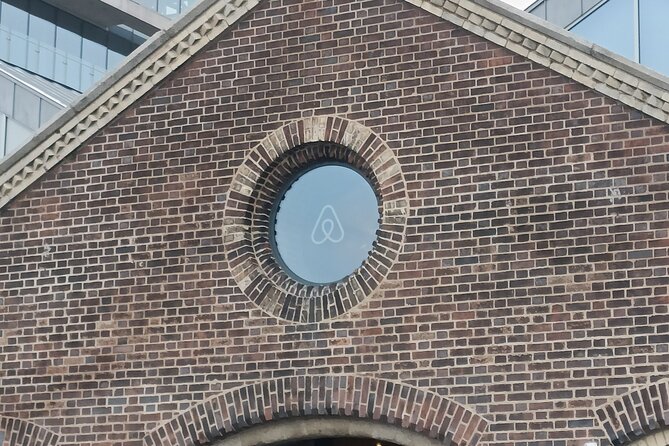
After you leave the Custom House, you’ll pass the quayside area. This section is where the Docklands look like the Docklands: historic warehouses mixed with modern development.
Why this matters for you: you’ll start spotting how the district evolved. You’re not just seeing buildings. You’re seeing a city adapting old harbor space for modern life. Even if you’re not an architecture nerd, the contrast helps the story land.
As you continue, the audio shifts from the economic engine to the human engine—labor and independence are part of this landscape, not side notes. That’s a smart approach because it keeps Docklands history from being only trade charts and ship timetables.
James Connolly, Liberty Hall Theatre, and labor history on the move
Next up is the memorial for James Connolly, a key figure in Ireland’s fight for independence and workers’ rights. Then you’ll pass Liberty Hall Theatre, tied to Dublin’s labor movement history.
This is one of the route’s strongest “meaning stops.” The Docklands were about work and shipping, but they were also about the people organizing around fairness. If you’ve ever wondered why labor history shows up in unexpected places, this gives you a grounded answer.
The only thing to watch here is pacing. Memorials can be quick to walk past, and the audio is your cue to slow down. If you like photos, this is a good stretch to stop and frame a couple shots. If you rush, you’ll miss the names and context the narration is putting in place.
Busáras, Connolly Station, and the Docklands as a transport crossroads
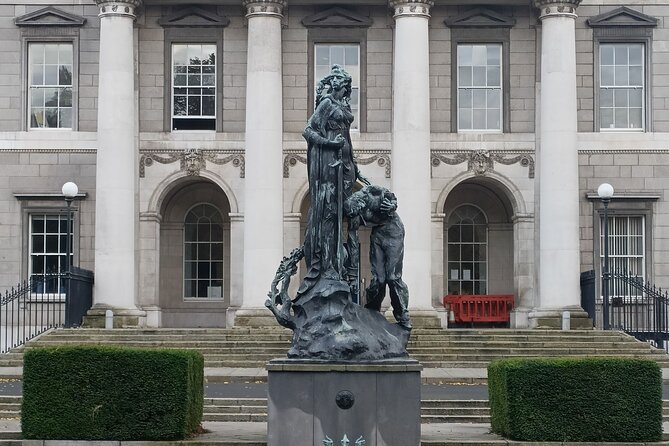
You’ll pass Busáras, Dublin’s central bus station, and then Connolly Train Station, one of the city’s main rail stations. This isn’t a “fun facts” detour. It’s part of what makes the Docklands useful today: movement.
You’ll feel the area’s role as a hub for connectivity. The audio helps connect the dots between the maritime traffic that once dominated here and the land-based transit that now defines the district’s daily rhythm.
If you’re using public transport for your whole trip, this is a practical bonus. You’re walking through a zone with options, so you can adjust on the fly—shorten the tour, extend it, or hop to another area without complicated planning.
You can also read our reviews of more guided tours in Dublin





IFSC and the skyline shift: from ships to finance
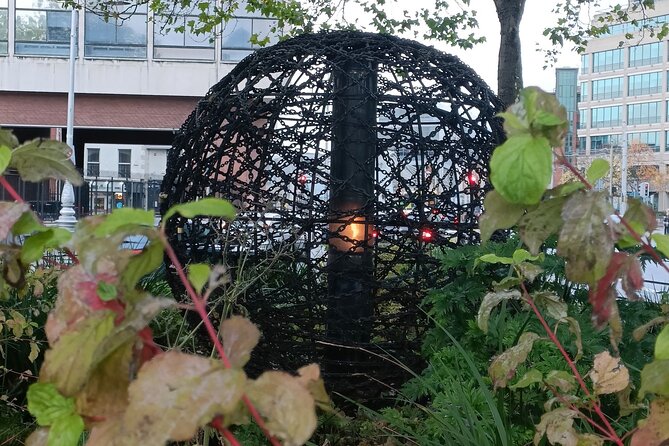
As you continue, you pass the IFSC, Dublin’s financial hub with multinational corporations and financial institutions. It’s the kind of contrast that makes Docklands feel like a living city rather than a museum.
For you, this section is a reminder that the Docklands story isn’t only about what happened. It’s also about what replaced it. The audio framing helps you understand why the skyline changed: the district became valuable for business, not just for ships.
If you’re the type who likes seeing how cities reinvent space, you’ll probably enjoy this stretch more than you expect. It’s also a good “eyes up” area for skyline views.
Triumphal Arch and the Scherzer Rolling Lift Bridges
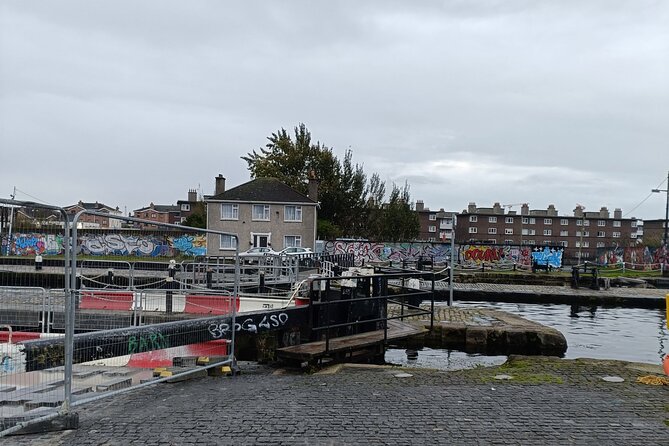
You’ll see the Triumphal Arch, commemorating Dublin’s maritime heritage and economic prosperity. It’s a clear signal that this place wants to remember its role in shipping and trade.
Then comes a technical highlight: the Scherzer Rolling Lift Bridges. These are presented as engineering marvels that once facilitated maritime traffic in the area.
This part is surprisingly fun if you’re even mildly curious about how cities work. Bridges are one of those things people glance at, but don’t think about. The audio gives you a reason to look closely, and that makes the scenery feel more intentional.
Tip: if it’s windy or cold, this is a good place to keep your jacket on and your pace steady. You’ll be out in open dock-and-river air.
Famine Memorial and the stories of those who were lost
Next, you pass the Famine Memorial, which pays tribute to those who suffered during Ireland’s Great Famine in the 19th century. Immediately after that, you’ll see a memorial honoring Irish seafarers who lost their lives at sea.
This is an emotional section, and the route doesn’t try to rush past it. The audio framing matters because it links suffering and survival to the geography you’re walking through. Docklands weren’t only a departure point for ships—they were part of the story of immigration, loss, and the harsh realities of the sea.
If you want photos, take them with intention. These memorials are meaningful, so a quick snap works less well than a calm look and a couple respectful frames.
The Jeanie Johnston replica and the Great Famine emigration theme
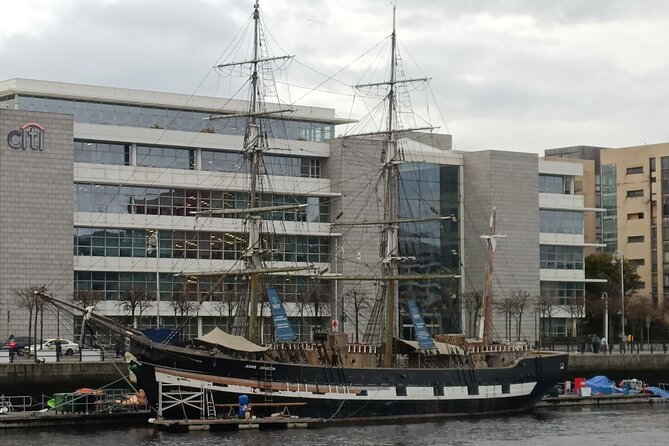
You’ll also see a replica of The Jeanie Johnston, a historic ship that carried Irish emigrants to North America during the Great Famine.
This is where the Docklands history becomes personal. The route is giving you the geography of migration, not just a general famine overview. Seeing a ship replica right in the harbor area helps your brain picture what people actually faced when they left.
If you’re traveling with kids or you’re not a “history stop” person, this is still worth the time. A ship replica does the teaching in a way that’s easier to digest.
Cross the Liffey on Seán O’Casey Bridge for views and momentum
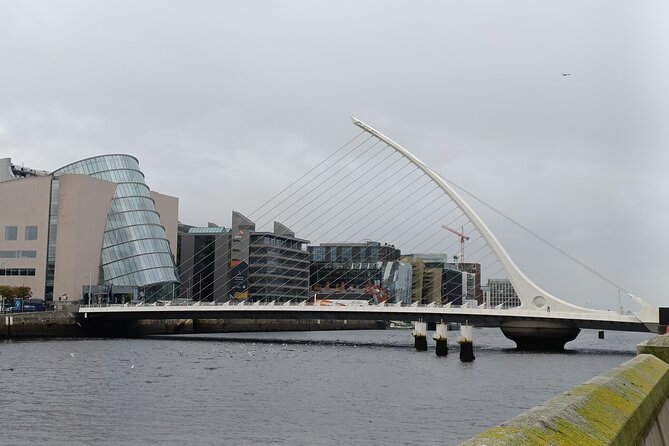
You’ll cross the River Liffey via the Seán O’Casey Bridge. This is your visual reset. Even if you’re not obsessed with city views, bridges force you to look. You get a skyline-and-water perspective that makes the rest of the walk feel like part of one continuous corridor.
On the other side, you continue with Samuel Beckett Bridge, another iconic modern bridge named after the writer. Even the naming theme helps. Dublin ties identity to the places you walk through, and this route makes that clear.
The practical upside: after a long stretch of history-related stops, crossing the river gives you something lighter—movement, views, and a sense of progress.
Convention Centre Dublin, Admiral William Brown, and port memory
You’ll pass by Convention Centre Dublin, a modern venue for conferences, events, and exhibitions. Next is the statue of Admiral William Brown, an Irish-born naval officer who founded the Argentine Navy.
This section mixes modern use with the port’s older reach. The maritime story extends beyond Dublin, and the route hints at how far seafaring influence traveled.
If you like seeing how local places connect to global stories, this is a good stretch to slow down. There’s enough here to make the “Dublin in the world” idea feel real rather than abstract.
Diving Bell and the maritime infrastructure details that people miss
Then you’ll see the historic Diving Bell, once used for dock maintenance in Dublin’s port.
This is one of those stops that can be easy to glance at and forget. But it’s exactly the kind of detail that makes an audio tour worth it: the narration turns an odd-looking piece of maritime equipment into something you understand in context.
If you enjoy hands-on history, this will land well. If not, you still get a moment that explains how the port worked beyond ships and bridges.
Tom Clarke Bridge (East-Link Bridge), BrewDog, and the “daily life” angle
You’ll pass Tom Clarke Bridge, also known as the East-Link Bridge, a vital transportation link connecting Dublin’s north and south. Then you’ll see BrewDog Outpost Dublin, a craft beer stop with a lively atmosphere.
This is a smart inclusion for readers who like practicality. Once you’re walking through heavy history and memorials, it helps to have an obvious “break spot” nearby. Not because you need beer to enjoy history, but because it gives your day shape.
Even if you don’t stop in, BrewDog helps you orient yourself. It’s a modern marker in a route that’s otherwise packed with older landmarks.
Sea lock, Grand Canal Docks sign, and the canal shift to Grand Canal Square
As you keep going, you pass the sea lock, an important piece of maritime infrastructure regulating water levels in the docks. Then you’ll see the Grand Canal Docks sign, marking the entrance to Dublin’s historic canal basin.
This is another theme shift: from river crossing and maritime traffic to canal heritage. If you like watching how a city’s water system changed roles over time, you’ll feel the story tighten here.
You’ll pass Hanover Quay, a waterfront area with residential and commercial developments. Then there’s Hanover Quay Studios, a recording studio complex frequented by musicians and artists.
That artistic layer near the end is a good payoff. The Docklands went from work and transport to creative industry and public-facing spaces.
Finally, you end at Grand Canal Square, with Red Sticks Dublin as the endpoint marker.
In practice, ending at Grand Canal Square is convenient. It’s a public space where it’s easy to keep your plans going—dinner, a walk around, or heading back toward central Dublin.
Price, timing, and why $11.99 can make sense
At $11.99 per person, the value depends on how you like to travel. If you enjoy self-paced exploration with a story running in your ear, this price is low enough to feel easy to justify. The tour also lasts about 50 minutes to 1 hour 10, so it doesn’t steal a huge chunk of your day.
The other value piece is the lifetime use and the fact that you can listen with the virtual playback option. That means you’re not stuck with one trip’s schedule. If you want to re-walk the route or you’re planning ahead, you can treat it like a flexible field guide.
And because it’s self-guided with GPS plus offline audio and maps, you’re not paying for a live guide’s time. You’re paying for a clear narrative route that makes the walking easier to interpret.
Logistics that matter: language, equipment, and where transit helps
This tour is offered in English and is private, meaning only your group participates. That’s usually a big plus for families or couples who want control over pacing.
The catch is you must bring a smartphone and headphones. The good news: if you already use your phone for maps in Dublin, you’re set. The included offline materials help you avoid hunting for signal mid-walk.
Timing is also easy. The endpoint area shows opening hours as open all day across the listed dates, so you’re not forced into a narrow time slot.
Finally, the location is friendly for public transit. The start point is approximately a 10-minute walk from O’Connell Street and about a 15–20 minute walk from College Green. You can also reach it via Busáras luas and bus stops, or the Tara Street DART station.
Who this Docklands walking audio tour is best for
I’d book this if you want history without a stiff schedule. It’s also a good pick if you like city walking but get bored when tours turn into long lectures.
This tour suits:
- People who prefer self-paced sightseeing
- Anyone who likes learning the “why” behind neighborhoods
- Travelers who want a quick win in one stretch of Dublin geography
It might not suit you as well if you need a live human presence to ask questions. This is narration-driven. You’ll get the context, but you won’t get back-and-forth explanations.
Should you book this Docklands audio walk?
Yes, if you want a short, well-structured way to understand Dublin’s shift from maritime power to modern Docklands. The route hits trade landmarks, labor history, emigration and famine memory, and a strong set of bridges and engineering details. The main practical reason to say yes is the combination of offline access plus a duration that fits almost any itinerary.
If you already know you don’t travel with headphones or you dislike audio-guided walking, then skip it and do Docklands sightseeing another way. But if you’re comfortable using your phone as a guide, this is one of the more cost-friendly ways to turn “just walking around” into a story you actually follow.
FAQ
How long is the self-guided walking tour?
It takes about 50 minutes to 1 hour 10 minutes.
What language is the audio tour available in?
The tour is offered in English.
Do I need my own smartphone and headphones?
Yes. The tour requires you to bring your own smartphone and headphones.
Can I use it with offline maps and audio?
Yes. You get offline access to audio, maps, and geodata to help save on data usage.
Where do I start and where does it end?
You start at the Custom House, North Wall, Dublin 1, and the tour ends at Red Sticks Dublin in the Dublin Docklands on the Grand Canal.
Is the tour refundable or changeable after booking?
No. It is non-refundable and cannot be changed for any reason.