REVIEW · DUBLIN
2-Hour Historical Walking Tour from Dublin
Book on Viator →Operated by Historical Walking Tours of Dublin · Bookable on Viator
Dublin’s history is written in stone and streets. This 2-hour walking tour ties together centuries fast, starting at Trinity College Dublin and ending near Christ Church Cathedral, with a history postgraduate guide who keeps the story moving. It is a smart way to learn the what and the why before you wander on your own.
I especially love the pacing: short stops with time to look around, plus a finish that leaves the rest of your day open. And I like that the route hits major landmarks tied to big turning points, not just random photos.
One thing to consider: this is politics-and-history heavy. If you want a light, culture-only stroll with minimal dates and conflicts, you may find the material dense.
In This Review
- Key points before you go
- Why a 2-hour Dublin history walk is a smart first move
- Meeting at the Grattan statue and finishing near Christ Church
- Stop 1: Trinity College Dublin and the Book of Kells context
- What to watch for at Trinity
- Stop 2: Bank of Ireland and the story of colonial parliament
- Drawback to consider here
- Stop 3: Temple Bar’s repurposing from demolition threat
- Quick tip
- Stop 4: Wood Quay Amphitheatre and the Viking layer beneath Dublin
- Stop 5: Four Courts and the Civil War spark in June 1922
- Why this stop matters
- Stop 6: Christ Church Cathedral and Strongbow’s 1170s rebuild
- Stop 7: City Hall and Daniel O’Connell the Liberator
- Stop 8: Dublin Castle and the Black Pool behind Dublin’s name
- Guides, style, and why some people call it too political
- Price and value: what $22.98 buys you here
- Walking comfort, weather, and how to dress
- Who should book this tour (and who might skip it)
- Should you book this 2-hour historical walking tour of Dublin?
- FAQ
- How long is the 2-hour historical walking tour?
- What does the tour cost?
- Where do I meet the guide?
- Where does the tour end?
- Is there a maximum group size?
- Is the tour offered in English?
- Do I get a mobile ticket?
- Is entry to the Book of Kells included?
- Is the tour suitable for everyone in terms of walking?
- Is free cancellation available?
Key points before you go
- Small group (max 25) keeps questions possible and the walk manageable.
- History postgraduate guides turn classroom-level detail into a street-level story.
- Start opposite Trinity at the Grattan statue so you can find it quickly.
- Eight major stops in about 2 hours gives you a clear Dublin orientation for the rest of your stay.
- Book of Kells is not included (you’ll get the context, then decide if you want to ticket it).
Why a 2-hour Dublin history walk is a smart first move
Dublin feels compact, but it is not simple. One street can hold medieval church power, British administration, and Irish political rebellion all within a short walk. This tour is designed for that reality: you get a guided timeline without spending half your vacation sitting in a museum.
The biggest payoff for me is how the tour sets you up to explore later. After the walk, you are not just saying I saw Trinity or I passed City Hall. You know what those places meant at the moment they mattered most, so your self-guided wandering clicks into focus.
Also, the format is practical. You plan for around two hours, then you still have the rest of the day to shop, eat, or revisit your favorite stop in your own time.
You can also read our reviews of more walking tours in Dublin



Meeting at the Grattan statue and finishing near Christ Church
The tour starts at the Henry Grattan Monument on College Green, directly opposite Trinity College Dublin’s front gate. That matters more than you might think. You avoid the usual Dublin chaos of hunting for a guide inside a busy entrance area.
The walk ends at Christ Church Cathedral, on Christ Church Pl near Wood Quay. This is a convenient finish because Christ Church sits right in a cluster of walkable sights. Even if you do not plan anything specific, you can naturally flow from the tour into more exploring without backtracking.
One more practical note: the tour uses a mobile ticket, and it is offered in English. Confirmation is handled at booking, and the tour operates near public transportation.
Stop 1: Trinity College Dublin and the Book of Kells context
You begin at Trinity College Dublin, one of Ireland’s best-known landmarks for education and learning. The tour explains Trinity’s place in Irish history as the oldest university in the country, founded in 1592.
You will also hear about the Book of Kells, the 8th-century manuscript of the Four Gospels written in Latin. It is one of those names you have heard before, but the guide helps make it feel real by connecting it to why cultural heritage matters in Ireland’s story.
Important for your planning: the tour includes admission related to the Trinity visit, but entry to the Book of Kells itself is not included. Translation: you will get the history framework here, then you decide later whether to add the ticket for the manuscript.
What to watch for at Trinity
This is one of the best stops to bring a curious pause. You are not just walking through a famous campus. You are standing in the setting where education, religion, and cultural identity overlap. If the weather is cold, you may appreciate that the stop is capped (about 20 minutes), so you are not standing around forever.
Stop 2: Bank of Ireland and the story of colonial parliament
Next comes the Bank of Ireland, built in 1729. Here the tour shifts from university learning to political power.
The guide explains that the building was originally Ireland’s colonial parliament and that it was abolished by the Act of Union in 1800. The point is not just dates. It is what the building symbolizes, especially in the era often described as Protestant Ascendancy. You get an architectural cue too: the neo-classical style that signals authority and control.
This is a short stop (about 10 minutes), which works well because the guide keeps it tight. You will learn what this location stood for and why it looks the way it does, without turning it into a lecture that lasts all day.
You can also read our reviews of more historical tours in Dublin





Drawback to consider here
If you are the type who loves stories told through buildings but hates political framing, this is where you might feel the pressure. The tour is not trying to hide the political context. It assumes you want the full picture.
Stop 3: Temple Bar’s repurposing from demolition threat
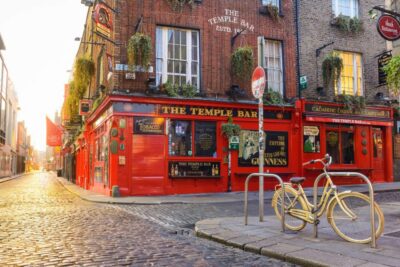
Then you move into Temple Bar. The tour gives it a key twist: the area was once earmarked for demolition, but the narrow street neighborhood was repurposed as Dublin’s Cultural Quarter in the 1990s.
This stop is about 10 minutes, so do not expect a long wander down every lane. Instead, think of it as a guided lens. When you look at Temple Bar after the tour, you will understand it as a planned rebranding of space, not just a place that became popular on its own.
Quick tip
If you like street-level culture, plan to come back after. Temple Bar is the kind of area you can enjoy more slowly once you know the backstory.
Stop 4: Wood Quay Amphitheatre and the Viking layer beneath Dublin
Wood Quay Amphitheatre is where you start seeing Dublin as a layered city. The tour points to archaeological excavations from the 1980s connected to the Viking city founded around AD 840.
It is a reminder that Dublin is not only medieval castles and church towers. Long before British administration and Georgian architecture, there was a settlement grid tied to Viking power. Standing here with that context changes how you read the city. You start noticing how modern Dublin sits over older Dublin.
This stop is also about 10 minutes, which is exactly right. You get the meaning of the site, then you can decide if you want to look further on your own.
Stop 5: Four Courts and the Civil War spark in June 1922
Four Courts is one of the heaviest stops on the route, and it is worth leaning into it.
The guide explains that Four Courts is Ireland’s legal headquarters. Then comes the dramatic part: a Civil War started in June 1922 here, between groups who supported and opposed the Treaty of December 1921 that ended the War of Independence (1919 to 1921).
This stop lasts about 20 minutes, longer than most on the walk. That extra time helps because it takes more words to explain how legal institutions can become flashpoints during political fractures.
Why this stop matters
If you remember nothing else from the tour, remember this: modern Ireland’s legal and political systems are not separate from the conflict that shaped them. The guide connects the courtroom to the reality that history is still in progress while the buildings stay standing.
Stop 6: Christ Church Cathedral and Strongbow’s 1170s rebuild
Christ Church Cathedral is the kind of place where your brain starts doing architecture math. The guide tells you it is Dublin’s oldest cathedral dating to 1030, and that it was rebuilt in stone in the 1170s by Strongbow.
Strongbow is described as central to the original English invasion in the 1170s. That connection matters because the cathedral becomes more than a church you pass. It becomes part of the wider story of English expansion and the way religious power traveled with it.
This stop is about 10 minutes, but it usually leaves people wanting more time inside—especially because Christ Church is visually impressive and historically layered.
Stop 7: City Hall and Daniel O’Connell the Liberator
City Hall is a quick stop, but it lands a powerful character story: Daniel O’Connell, Dublin’s first Catholic Lord Mayor in 1840, remembered for leading the campaign for Catholic Emancipation (1829).
The guide explains that emancipation meant the end of anti-Catholic laws, which is why O’Connell is known as The Liberator. Even in a short time, this stop helps connect Irish nationalism, religion, and political reforms.
This is around 10 minutes, but if you like speeches, slogans, and personal political power, you will likely find it one of the more memorable moments.
Stop 8: Dublin Castle and the Black Pool behind Dublin’s name
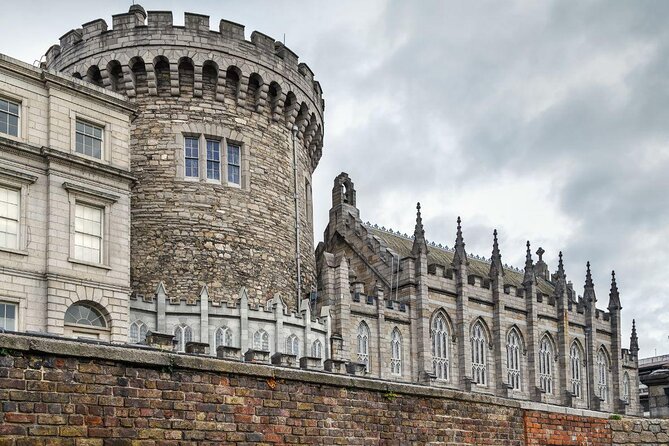
The final stop is Dublin Castle. The tour covers it as the British administration seat until 1922, with origins tied to King John in 1204.
You also get a language nugget that changes how you think about the name Dublin. The guide explains that the location of Dubh Linn, the Black Pool, is connected to how Dublin gets its name.
This stop is about 10 minutes, and it works as a strong wrap-up. You finish with the sense that Dublin’s identity was formed by overlapping forces: medieval English rule, British administration, Irish political change, and names that still echo older geography.
Guides, style, and why some people call it too political
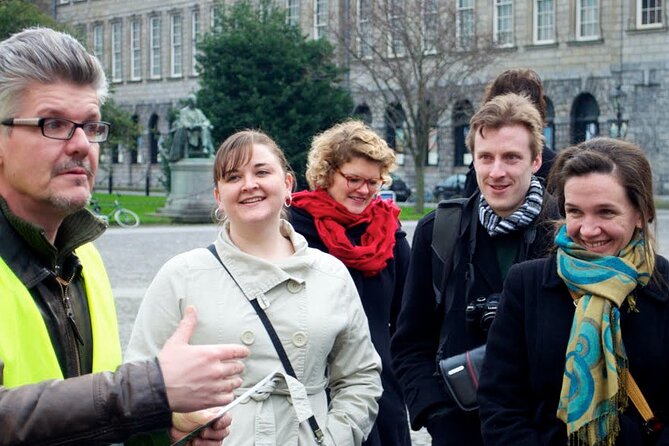
This tour’s structure depends on its guide. The guides are all history postgraduates, and that shows in how they handle detail. They explain timelines, but they also explain why people fought, voted, published, and changed laws.
That is also why the tour earns its almost universally high rating. Many people come away feeling like the guide can answer questions and speak clearly even when the group is dealing with real weather.
At the same time, one recurring consideration is that the tour can feel like a lot if you were hoping for a lighter cultural scan. Some people want more street atmosphere, fewer conflicts, fewer political connections. If that is your vibe, you might feel overloaded, and the walk can run a little long depending on how questions and conversations develop.
My practical advice: treat this as a history lesson you take while walking. If you want culture, you can add it afterward. If you want context, this tour is one of the fastest ways to get it.
Price and value: what $22.98 buys you here
At about $22.98 per person for roughly two hours, this is good value if you like understanding what you are seeing.
Here is why the price makes sense:
- You are paying for a trained guide (not just directions).
- The group is capped at 25, which matters for the quality of explanations.
- Several site-related entries are handled as free admissions for the tour stops, so you are not paying a pile of small fees at every corner.
- You spend a short, guided block of time and then get the rest of the day to use as you want.
The one thing you should watch: the Book of Kells entry is not included. You may still want to buy that ticket if the manuscript is a priority for you. But the tour helps you decide because you will understand what you would be paying to see.
If your goal is day-one orientation and history context without getting trapped in a museum schedule, this price is usually a solid bargain.
Walking comfort, weather, and how to dress
This is a walking tour with moderate physical fitness level required. The walk is not described as extreme, but it is still a city-center route with repeated short segments.
Also, Dublin weather loves to humble everyone. People often mention freezing or rainy conditions, so plan to layer up and bring outerwear you can tolerate for a couple hours.
A practical checklist:
- Comfortable walking shoes (you will be on sidewalks most of the time)
- Warm layers that can handle wind
- A rain layer you can keep on without wrestling it every five minutes
- A phone charged enough for the mobile ticket
If you do those basics, the experience stays enjoyable rather than stressful.
Who should book this tour (and who might skip it)
Book it if:
- You want a fast, structured view of Dublin’s development from older power centers through modern political change
- You like guides who explain connections between places, not just facts about individual buildings
- You want a strong start to a multi-day Dublin trip, then freedom to revisit afterward
Consider skipping or choosing a different style if:
- You want a light cultural stroll with minimal politics and fewer dates
- You know you get impatient with history lessons that are more academic than atmospheric
- You are trying to fit in many other tight plans during your first afternoon (because the tour can take a bit more time depending on how the group engages)
Should you book this 2-hour historical walking tour of Dublin?
If you are the type who likes to understand what you are looking at, this is a great early booking. The route is efficient, the stops are major, and the guide format keeps you from getting lost in a sea of names and eras.
I would book it especially if Dublin is your first Irish city and you want the big picture right away. Skip it only if you are strongly allergic to political context and prefer purely casual sightseeing.
FAQ
How long is the 2-hour historical walking tour?
It runs for about 2 hours.
What does the tour cost?
The price is $22.98 per person.
Where do I meet the guide?
The start point is the Henry Grattan Monument on College Green, opposite Trinity College Dublin’s front gate.
Where does the tour end?
It ends at Christ Church Cathedral, Christchurch Pl, Wood Quay, Dublin (D08 TF98).
Is there a maximum group size?
Yes. The tour has a maximum of 25 travelers.
Is the tour offered in English?
Yes, it is offered in English.
Do I get a mobile ticket?
Yes. The tour uses a mobile ticket.
Is entry to the Book of Kells included?
No. Entry to the Book of Kells is not included.
Is the tour suitable for everyone in terms of walking?
It requires a moderate physical fitness level. The walking is in a city center setting.
Is free cancellation available?
Yes. You can cancel up to 24 hours in advance for a full refund.