REVIEW · DUBLIN
Dublin Live Guided Panoramic Open-Top Night Bus Tour
Book on Viator →Operated by Big Bus Tours Dublin · Bookable on Viator
Dublin after dark is easier than you think. This one-hour open-top night bus tour threads together top sights, from the General Post Office to Trinity College, with a guide who keeps things lively as streetlights come on.
I really like the live guide style, often funny and quick with practical stops and recommendations, like the kind of narration people praise with guides such as Jerry, Paul, Liam, Nile, and Brian. You also get a tight overview loop in just about an hour, so your first evening can help you decide what to explore on foot next.
My only caution: night lighting and street conditions can vary, so not every landmark will look like a perfect postcard glow from the bus.
In This Review
- Key things to know before you board
- Why Dublin looks different after the sun drops
- Boarding at 13 O’Connell Street Upper: the one-hour reality
- GPO to the Liffey: Dublin’s big crossroads at night
- The Jeanie Johnston and Samuel Beckett Bridge: memory meets modern Dublin
- Trinity College, Merrion Square, and the Oscar Wilde Statue
- St Stephen’s Green and Molly Malone: the fun stops you’ll remember
- Temple Bar to Dublin Castle: pub energy and power architecture
- Christ Church Cathedral: a strong finish for your first night out
- Price and value: why $31.38 can make sense
- How to get clearer audio and better photos
- Who this Dublin night bus tour is best for
- Should you book this Dublin night bus tour?
- FAQ
- How long is the Dublin night bus tour?
- Where is the meeting point and where does the tour end?
- Is this an open-top bus tour?
- Is this tour hop-on hop-off?
- What language is the tour offered in?
- What major stops are included on the route?
- How many people is the tour limited to?
- Are service animals allowed?
- Is free cancellation available?
Key things to know before you board
- Open-top panoramic night ride designed for landmark views as Dublin cools off
- A set route, not hop-on hop-off, so you stay on the bus for the full loop
- Stops that cover big Dublin stories from GPO and the Liffey to Temple Bar and Dublin Castle
- Live narration with humor that can make architecture and history easier to follow
- About 1 hour on board, so photo stops are usually brief
- Starts and ends at 13 O’Connell Street Upper, convenient for the city center
Why Dublin looks different after the sun drops
Dublin at night has a gentler pace. Daytime crowds thin out, shop signs and office windows glow, and the streets feel more walkable even if you’re still using transit.
On this tour, the city’s landmarks are treated like a moving photo album. You’re going to see how areas connect: the formal streets around Trinity, the river corridor, the literary and park zones, and then the pub-and-cobblestone atmosphere near Temple Bar.
And the best part is you don’t need a plan. You just ride, listen, and let the route give you a sense of where everything sits.
You can also read our reviews of more guided tours in Dublin
Boarding at 13 O’Connell Street Upper: the one-hour reality
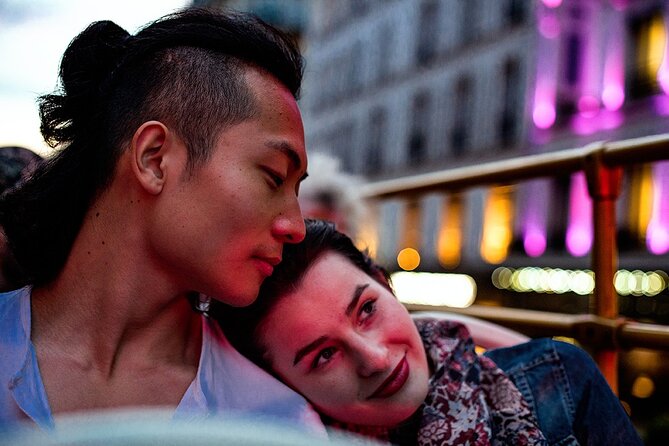
Your meeting point is 13 O’Connell Street Upper, and the tour ends back there. That matters because you don’t have to worry about where your evening finishes, or how you’ll get home afterward.
The tour runs about 1 hour, which is short enough to fit into a travel day with a late dinner. It’s also long enough to cover a real mix of sights, not just a few blocks.
One more practical detail: the group size is capped at 75 travelers. That’s not tiny, but it usually means you can still find a good view and keep your listening organized.
GPO to the Liffey: Dublin’s big crossroads at night
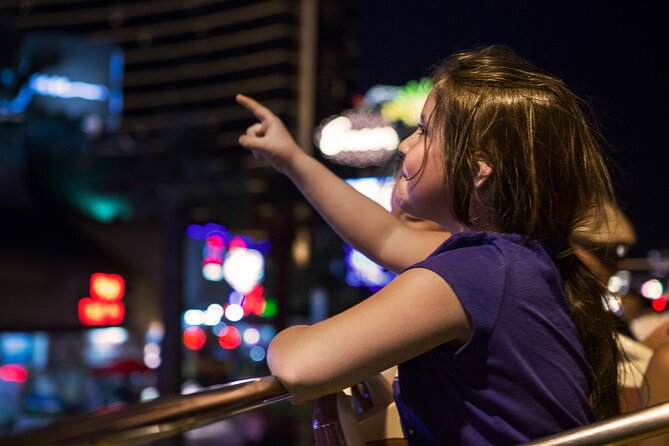
The ride opens at the General Post Office area. Even if you’re not a history nerd, the GPO is one of those buildings that anchors Dublin’s identity. At night, its role in the city feels less like a textbook date and more like a defining moment in the street grid.
From there, you’re in the River Liffey zone. This is where Dublin becomes more than buildings. The river acts like a visual spine, and you start to see why so many key streets funnel toward it.
If you’re into photos, aim for the moments when the bus turns so you get a cleaner line of sight across the water and along the embankments. Night shots can be forgiving, because point lights and reflections do half the work for you.
The Jeanie Johnston and Samuel Beckett Bridge: memory meets modern Dublin
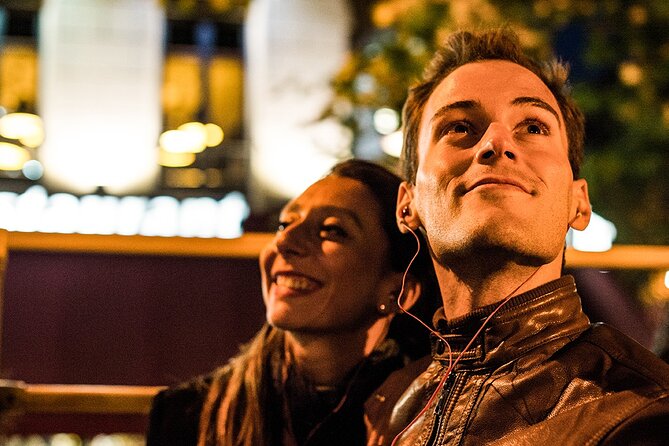
Next up is The Jeanie Johnston: An Irish Famine Story. Even without stepping out, the stop helps put people and place into the same frame. It’s a reminder that Dublin’s story includes more than pubs, even when the evening mood turns festive.
Then the route swings toward Samuel Beckett Bridge. This is one of those night scenes that can look dramatic even from a moving bus, because the structure catches light and frames the river corridor.
The key trick here is pacing your expectations. The bus is moving, the light is changing, and you’re not doing museum-style viewing. Think of each stop as a snapshot and an orientation marker, not a long photo session.
Trinity College, Merrion Square, and the Oscar Wilde Statue
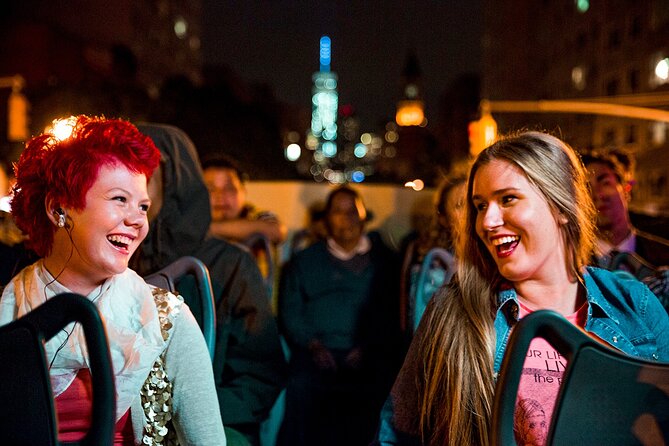
Trinity College Dublin is the kind of landmark that makes you sit up. It’s instantly recognizable, and at night it feels more cinematic—especially when the surrounding streets are quieter.
Then you’ll head toward Merrion Square. Squares in Dublin have that calm, ordered feel even when the city is busy. Seeing it at night helps you understand why these areas are prized for walking and day-to-day city life.
You also stop for the Oscar Wilde Statue. Wilde is more than a name on a brochure; he’s woven into Dublin’s self-image. When you hear the narration tie him to the city streets, it clicks that Dublin’s literary culture isn’t a museum exhibit. It’s part of the urban fabric.
If you’re hoping to get a sharp photo here, position yourself for less glare from the bus lights. Windows can reflect interior lighting, so try to angle your phone or camera slightly away from bright reflections.
You can also read our reviews of more evening experiences in Dublin
St Stephen’s Green and Molly Malone: the fun stops you’ll remember
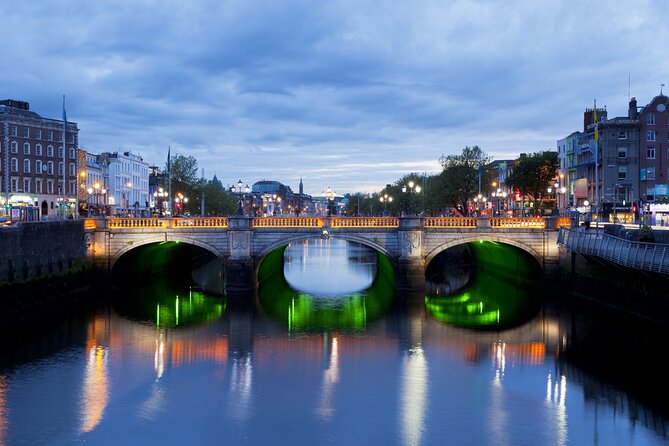
St Stephen’s Green is one of the most recognizable parks in central Dublin. At night, it shifts from daytime bustle into something calmer, with the paths and edges defined by lighting rather than crowds.
Then comes Molly Malone Statue. Molly is Dublin’s most famous character-style figure, and the stop is basically a fast introduction to the city’s humor and myth-making. Even if you already know the song, seeing the statue in context helps it feel like part of the street map, not just lyrics.
For me, this part of the route is valuable because it breaks the pattern of “big monuments only.” You’re getting moments that are playful, human, and easy to connect to later on when you’re walking on your own.
Temple Bar to Dublin Castle: pub energy and power architecture
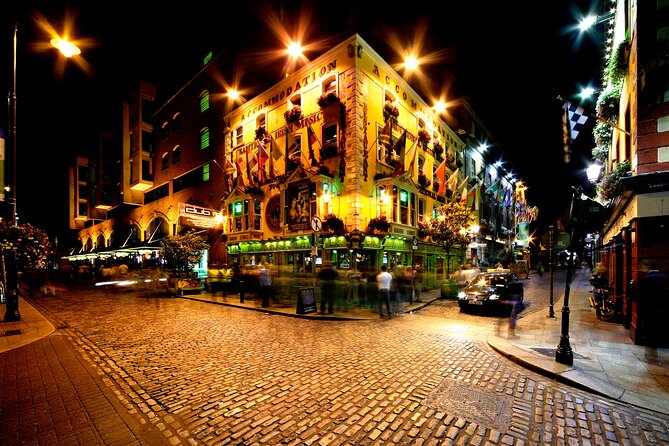
When the route reaches Temple Bar, you’re stepping into Dublin’s nightlife brand. At night, the signage and street lighting do a lot, and the area’s energy becomes obvious even from the bus.
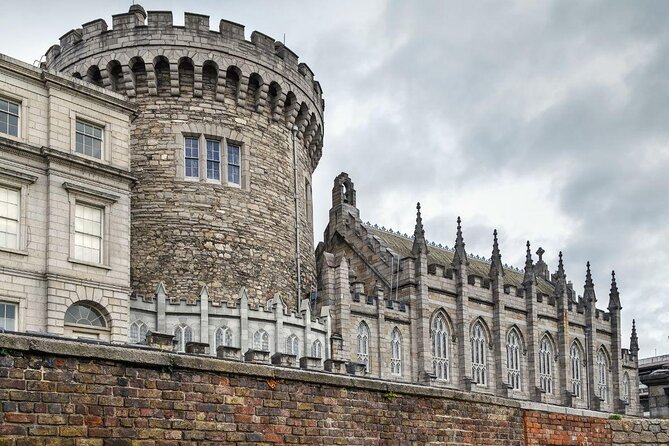
After that, Dublin Castle brings a different mood. It’s authority and old stone, lit up in a way that emphasizes shape and edges. If you’ve ever wondered how Dublin balances storybook charm with serious institutions, this contrast is the quick answer.
This segment works well if you’re arriving for the first time and want to know where the city’s extremes live side by side: entertainment and establishment within the same evening ride.
Christ Church Cathedral: a strong finish for your first night out
The route ends with Christ Church Cathedral. This is one of Dublin’s most visually commanding landmarks, and at night it tends to read clearly from a distance.
A good night-tour stop should do two things: close the loop and make you feel like you learned something. Ending here gives you both. You get a final “anchor point,” so when you wake up the next morning, you’re not starting from zero.
Even if the glow isn’t perfect everywhere, you’ll still leave with a mental map. That’s the real value of an hour like this: it helps you navigate your next decisions.
Price and value: why $31.38 can make sense
At $31.38 per person for about an hour, this tour isn’t trying to be the cheapest way to see Dublin. It’s priced more like a convenience deal: you pay for time-saved sight coverage plus narration.
The value comes from the combination:
- You cover a dense set of landmarks without figuring out routes or timing
- You get live commentary that turns stops into a story, not a list
- You’re shown how the city looks when lights turn on, which helps you plan evening walking later
One practical thing to watch: a review mentioned the online cost being higher than the on-street option, and the company response suggested checking purchase options. So if you’re price-sensitive, compare options and don’t assume every channel charges the same.
If you only have one or two nights in Dublin, an hour like this is often worth it. If you’re staying longer and already know your route, you might prefer walking and spending that money on guided museum time instead.
How to get clearer audio and better photos
Night tours live or die by your listening position. Some people have found the commentary hard to catch when crowds nearby get loud. If you want the best chance:
- Sit where you can face the guide’s audio direction
- Use the window space well, instead of crowding into glare zones
- Keep your camera ready before the bus slows, since timing can be tight
There’s also a helpful detail: complimentary headphones are available at the bus entrance for the pre-recorded commentaries. If you’re worried you’ll miss pieces, grab them. It’s an easy upgrade to your understanding.
For photos, accept the tradeoff. This is a moving tour with short sight moments. If you go in expecting long stops for every building, you’ll get impatient. If you go in expecting quick scene captures, you’ll come out happier.
Who this Dublin night bus tour is best for
This is a great fit if:
- You want a first-night orientation to help you plan the rest of your trip
- You’d rather ride than navigate in the dark
- You like light history explained in plain language, with humor
It’s also a strong choice for visitors who want to see both classic Dublin and the more modern riverfront rhythm, without committing to a half-day walking plan.
It may be less ideal if you need lots of time at each spot. The format is designed for coverage, not deep lingering.
Should you book this Dublin night bus tour?
Yes, I’d book it if you want a fast, low-effort way to understand where Dublin’s main sights sit and how they look when the lamps turn on. For most first-timers, an hour is enough to build confidence for the rest of your days.
I’d think twice if you’re expecting a fully lit, postcard-perfect night view everywhere. Night lighting varies, and the bus timeline is tight. If your top priority is long photo time or prolonged stop-and-explore moments, you might be happier with a walking plan or a different style of tour.
FAQ
How long is the Dublin night bus tour?
It runs for about 1 hour.
Where is the meeting point and where does the tour end?
The tour starts at 13 O’Connell Street Upper in North City and ends back at the same meeting point.
Is this an open-top bus tour?
Yes. The experience is described as a panoramic night tour on an open-top bus.
Is this tour hop-on hop-off?
No. It is not a hop-on hop-off tour.
What language is the tour offered in?
The tour is offered in English.
What major stops are included on the route?
Key stops include the General Post Office, River Liffey, The Jeanie Johnston: An Irish Famine Story, Samuel Beckett Bridge, Trinity College, Merrion Square, Oscar Wilde Statue, St Stephen’s Green, Molly Malone Statue, Temple Bar, Dublin Castle, and Christ Church Cathedral.
How many people is the tour limited to?
The maximum group size is 75 travelers.
Are service animals allowed?
Yes, service animals are allowed.
Is free cancellation available?
Yes. You can cancel up to 24 hours in advance for a full refund.