REVIEW · DUBLIN
Small Group Bucket List Sights Walking Tour with a Local Guide
Book on Viator →Operated by Yellow Umbrella Tours Ltd · Bookable on Viator
Dublin history fits in two hours. This small-group walk strings together big-name stops and the stories behind them, so Dublin starts to make sense fast.
I like that it’s easy to follow at a human pace, with a guide who can answer questions along the way. I also love the mix of sacred sites, government power, and Liffey views—so your stroll feels like a tour of eras, not just a checklist.
One thing to plan for: several stops are view-only, and admission tickets are not included for key places like Christ Church, St. Patrick’s, Dublin Castle, and Trinity College’s Book of Kells area.
In This Review
- Key highlights you’ll feel on this walk
- Why a 2-hour Dublin highlights walk makes sense
- Christ Church Cathedral: Vikings to stone, with whiskey-era renovation
- St. Patrick’s Cathedral: Guinness family renovations and a patron-saint myth
- Dubh Linn Gardens and the Chester Beatty Library: a quiet pocket with deep roots
- Dublin Castle: 700 years of British government in layered architecture
- City Hall flag stop: the national flag as a peace story
- Temple Bar: from Tudor conquest layout to modern pub culture
- Millennium Bridge and Ha’penny Bridge: two Liffey views with engineering stories
- Merchant’s Arch to College Green: Dublin’s contrasts in one line
- Molly Malone and the Trinity College finish: closing with an icon
- Price and what you really get for $20.52
- Pacing, group size, and the guide effect (Peter and Martin stood out)
- Who this tour suits best—and who might want a different style
- Should you book this Dublin Christ Church-to-Trinity walking tour?
- FAQ
- How long is the walking tour in Dublin?
- What does the tour cost?
- Is this a small group tour?
- What language is the tour offered in?
- Is admission included for the stops?
- Where do I meet the guide?
- Where does the tour end?
- What time does the tour start?
- Are service animals allowed?
- Is there free cancellation?
Key highlights you’ll feel on this walk
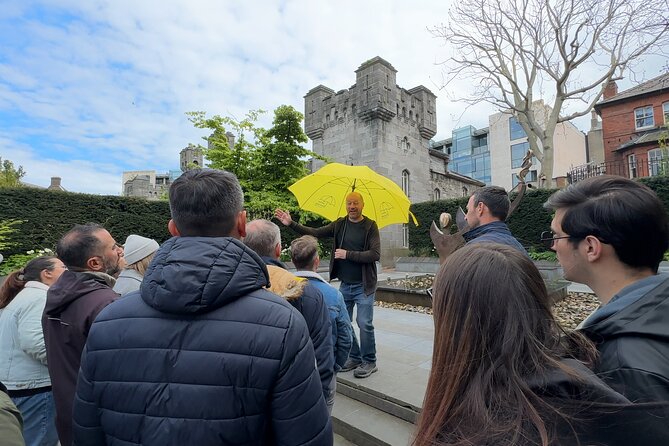
- Small group size (max 25) keeps the conversation going and questions from dying on the sidewalk.
- Two bridges, two different stories: Ha’penny Bridge’s design details and the wider Liffey view from Millennium Bridge.
- Power, religion, and politics in one route from cathedrals to Dublin Castle to College Green.
- Viking-to-modern contrasts at Dubh Linn Gardens, Merchant’s Arch, and Trinity College.
- Local-guide energy: both Peter and Martin received top marks for their enthusiasm and clear explanations.
Why a 2-hour Dublin highlights walk makes sense
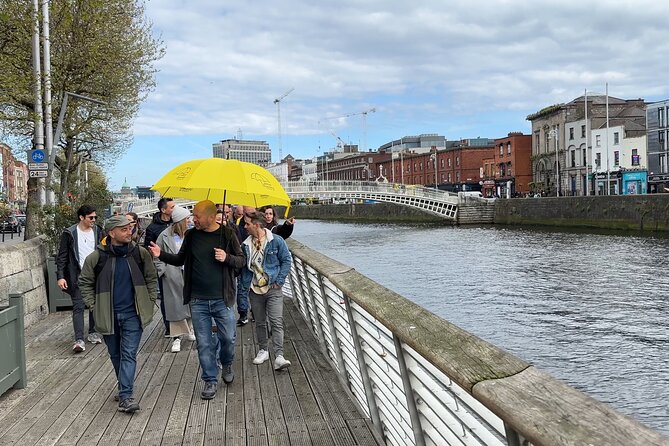
If you’re only in Dublin for a short stretch, you want two things: orientation and context. This tour delivers both. In about 2 hours, you cover the city center on foot and stitch together the “why” behind what you’re seeing—Vikings, Normans, British rule, and Ireland’s own modern identity.
The route also has a practical rhythm. Each stop is short, roughly 10 minutes, which keeps you moving without turning the experience into a sprint. And because it’s a small group (up to 25), you’re more likely to get your specific questions answered than just hear facts read out like a phone script.
Finally, you end in a smart place for continuing your day. The walk finishes outside Trinity College on College Green, which makes it easy to pick up another attraction right away (especially if Book of Kells is on your must-see list).
You can also read our reviews of more walking tours in Dublin



Christ Church Cathedral: Vikings to stone, with whiskey-era renovation
You start at Christ Church Cathedral, and the first thing you learn is that Dublin’s “old” buildings have layered backstories. The cathedral traces roots to an earlier Viking-built structure, later recast in stone after the Normans arrived. Then comes a newer twist: the 19th-century renovation funded with whiskey money.
What I like about kicking off here is that it sets the tone. You’re not just looking at architecture—you’re watching Dublin’s power shift over centuries. The guide helps you connect the timeline to the physical site, which makes the cathedral feel less like a standalone landmark and more like a marker on a long timeline.
A small consideration: admission isn’t included. So you’ll likely enjoy the exterior and the area’s storytelling, but if you want to go inside, you’ll need to plan for separate ticket time and cost.
St. Patrick’s Cathedral: Guinness family renovations and a patron-saint myth
Next up is Saint Patrick’s Cathedral, tied to the country’s best-known patron-saint story. You’ll hear the tradition about St. Patrick driving snakes off the island, and you’ll also hear how the site was superbly renovated in the 1860s by the Guinness family—specifically Sir Benjamin Lee Guinness.
This stop works well even if you’re not a hardcore church person. Why? Because the guide frames the building in terms of Irish identity: religion, myth, and modern civic pride all show up in the story of how the cathedral took its current form.
Again, admission ticket isn’t included, so expect more of a quick orientation-and-context stop than a full inside visit.
Dubh Linn Gardens and the Chester Beatty Library: a quiet pocket with deep roots
After the bustle of cathedral streets, you get a calmer pause at Dubh Linn Gardens. This is where the tour turns thoughtful. The gardens are home to the Chester Beatty Library, and the space is also tied to Viking history—long boats moored here when the Vikings first arrived in Dublin in the 9th century.
One of my favorite things about this part of the walk is how it changes the mood. You go from big monuments to a secluded area where the details feel more human. Even if you don’t go into the library itself, you still get that useful “oh wow, it was here that ships came in” moment.
Good news for your budget: this stop is marked free for admission.
Dublin Castle: 700 years of British government in layered architecture
Then you hit Dublin Castle, and the tour doesn’t treat it like just another impressive facade. It’s described as the center of British government in Ireland for 700 years, and you’ll notice the building’s changing style over time—medieval, Georgian, Gothic, and modern elements all mixed together.
This is where the tour’s biggest value shows up: it gives you a lens. Instead of saying Dublin’s history is complicated, it shows you how that complexity lives inside stone. You start to see the city as a series of eras building on each other, not a single “timeline” you can memorize and move on from.
One practical point: admission isn’t included for Dublin Castle. So if you want to tour rooms inside, you’ll need to add that separately.
You can also read our reviews of more guided tours in Dublin






City Hall flag stop: the national flag as a peace story
Outside the castle area, you’re guided past City Hall for a special kind of lesson. The guide explains the significance of the national flag—peace between Catholic and Protestant communities, North and South.
This is quick—about 10 minutes—but it’s meaningful. It’s also one of those moments where the tour does more than point at sights. It helps you understand why symbols matter in Dublin, and why the city’s past isn’t just academic.
This is also marked as free, and it’s a strong stop if you want a connection between history and what people carry forward into everyday public life.
Temple Bar: from Tudor conquest layout to modern pub culture
Next comes the part of Dublin many people already know: Temple Bar. But the tour avoids treating it like a postcard of pubs. You’ll hear how the area was laid out during the Tudor conquest of Ireland—which reframes the present-day nightlife as something rooted in older city planning.
Does that make Temple Bar less fun? Not at all. It makes it more interesting. You start seeing the streets as structure, not just entertainment zones. And it helps you connect why this neighborhood became famous in the first place.
This stop is free for admission, and it’s also a good time to watch the street level for street patterns, building frontages, and general “how the city grew” clues.
Millennium Bridge and Ha’penny Bridge: two Liffey views with engineering stories
By the time you reach the Millennium Bridge, you’re set up for one of the best “walk-and-look” moments. You cross the Liffey from south to north, then take in a city view from the east and west. The tour links that view to ancient and modern Dublin: the Celts built a settlement about 2,100 years ago, and the west side connects to more recent history with the American-inspired Silicon Docks reference from about 21 years ago.
This is also a practical photo stretch. You get a good sense of how riverside sections connect, and why the Liffey is basically the city’s spine.
Then you return south over Ha’penny Bridge. You’ll hear the story behind the name—originally associated with the Duke of Wellington—and a technical detail that adds personality: you can thank Harland & Wolff because the bridge no longer shakes when you walk over it.
Both bridge stops are about 10 minutes each and are not included for admission where tickets would otherwise apply, but you’re mostly using them for the views and the guide’s context.
Merchant’s Arch to College Green: Dublin’s contrasts in one line
At Merchant’s Arch, the tour spotlights Dublin’s contrast. One end of Crown Alley ties to the older, more historic feel of the city, while the other end points toward Sam Stephenson’s brutalist presence—Stephenson Tower. It’s a quick way to see how Dublin can hold old and new attitudes in the same frame.
Then you move to College Green, where the emphasis turns back to governance and finance. The guide points out how College Green was a center of government and money for a city that saw itself as the 2nd city of the empire. The area’s buildings give you a strong sense of institutional Dublin.
This is a free stop, and it’s a useful one if you want to understand why College Green feels like the formal “government face” of the city.
Molly Malone and the Trinity College finish: closing with an icon
No Dublin center walk feels complete without a quick hello to Molly Malone Statue. This stop is short, but it helps you end with a cultural touchstone rather than only political buildings. Molly Malone is Dublin’s famous character—and the guide makes the figure part of the city’s story, not just a selfie spot.
Then you conclude outside Trinity College Dublin, home to the famed Book of Kells exhibition. You get a fitting finish: a site tied to scholarship and Irish cultural heritage, with plenty of options to continue after the tour ends.
The tour’s end point is Fox House, 37 College Green, on the outside of Trinity College’s front gate, so you’re not stuck trying to navigate away from the historic center.
Price and what you really get for $20.52
At $20.52 per person, this tour is priced in the “good value” zone for a city-center walking experience. You’re paying for three things that are hard to replicate alone:
- A guided route that hits key landmarks in a logical order
- Short storytelling at each stop so you don’t spend your vacation reading history walls
- Small-group conversation with a guide who can respond to questions
The trade-off is that it’s not an all-in admission tour. Several major sights have admission tickets not included, including Christ Church, St. Patrick’s, and Dublin Castle. That’s not bad—it just means the tour is best seen as orientation plus context. If you want interior entry, treat the cathedrals and castle as optional add-ons you can choose based on time and interest.
If you’re the type who likes to move fast and then build your own plan afterward, this pricing structure fits you well.
Pacing, group size, and the guide effect (Peter and Martin stood out)
The tour is designed around frequent, short stops—about 10 minutes each—so you keep seeing new streets and new architectural styles. That matters. If the stops were longer, this walk could feel heavy. As it is, it feels like a smooth overview you can build on.
You also get a real advantage from the human part of the experience. In the reviews, guides like Peter and Martin received praise for being engaging and enthusiastic, with a clear command of Dublin’s history and practical suggestions for what to do next.
Even when the stops don’t include going inside buildings, the tour still feels productive because the guide connects details to what you’ll notice later on your own.
Who this tour suits best—and who might want a different style
This is a great match for:
- First-time visitors who want the city center mapped out quickly
- Travelers who enjoy history when it’s told in plain language, tied to places you can see
- People planning a short stay and wanting a starting point before branching out
It might feel less ideal for:
- You want long museum-style visits or lengthy guided interior tours (since entry is not included for several key stops)
- You prefer a slower walk with more time sitting and less moving between stops
If you’re somewhere in the middle—seeing the highlights, understanding them, then choosing what to do next—this walk hits a sweet spot.
Should you book this Dublin Christ Church-to-Trinity walking tour?
Yes, if you want a high-return, two-hour orientation through Dublin’s biggest center landmarks. For $20.52, you get a solid route, smart storytelling at each stop, and an end point on College Green that makes it easy to keep exploring.
Book it especially if you like your Dublin history tied to real places—Viking mooring points, cathedral renovations by major Irish families, centuries of government in one complex, and modern Dublin reflected in bridge views. Just go in expecting a guided overview, not a full admission tour, and you’ll get exactly what you paid for.
FAQ
How long is the walking tour in Dublin?
It runs for about 2 hours (approximately).
What does the tour cost?
The price is $20.52 per person.
Is this a small group tour?
Yes. The maximum group size is 25 travelers.
What language is the tour offered in?
The tour is offered in English.
Is admission included for the stops?
Not for every stop. The tour notes that admission tickets are not included for places like Christ Church Cathedral, Saint Patrick’s Cathedral, and Dublin Castle. Some areas are free to visit (for example Dubh Linn Gardens, City Hall area, Temple Bar, and College Green).
Where do I meet the guide?
You meet at 121 R137, Wood Quay, Dublin, Ireland.
Where does the tour end?
The tour ends at Fox House, 37 College Green, Dublin 2, outside the front gate of Trinity College.
What time does the tour start?
The start time listed is 10:00 am.
Are service animals allowed?
Yes. Service animals are allowed.
Is there free cancellation?
Yes. You can cancel for a full refund if you cancel up to 24 hours in advance of the experience start time.